I introduced a friend to ATLA a few nights ago, and they had only
known two things about the entire show: the cabbage meme, and that Aang
apparently wants to ride every large and dangerous animal he can
possibly find. We got through the first five or so episodes, and my
friend noted that Aang is exactly what a 12-year-old would be like if
given godlike powers, and that this is literally just what he
could do with airbending. He can’t even wield any of the other elements,
and he’s one of the most powerful people on the planet, because he’s an
airbender.
And that got me thinking.
This snippet from Bitter Work is one of the few pieces of concrete information we get about the airbenders, at least in ATLA. Iroh is explaining to Zuko how all four of the elements connect to the world and to each other.
Fire is the element of power, of desire and will, of ambition and the ability to see it through. Power is crucial to the world; without it, there’s no drive, no momentum, no push. But fire can easily grow out of control and become dangerous; it can become unpredictable, unless it is nurtured and watched and structured.
Earth is the element of substance, persistence, and enduring. Earth is strong, consistent, and blunt. It can construct things with a sense of permanence; a house, a town, a walled city. But earth is also stubborn; it’s liable to get stuck, dig in, and stay put even when it’s best to move on.
Water is the element of change, of adaptation, of movement. Water is incredibly powerful both as a liquid and a solid; it will flow and redirect. But it also will change, even when you don’t want it to; ice will melt, liquid will evaporate. A life dedicated to change necessarily involves constant movement, never putting down roots, never letting yourself become too comfortable.
We see only a few flashbacks to Aang’s life in the temples, and we get a sense of who he was and what kind of upbringing he had.
This is a preteen with the power to fucking fly. He’s got no fear of falling, and a much reduced fear of death. There’s a reason why the sages avoid telling the new avatar their status until they turn sixteen; could you imagine a firebender, at twelve years old, learning that they were going to be the most powerful person in the whole world? Depending on that child, that could go so badly.
But the thing about Aang, and the thing about the Air Nomads, is that they were part of the world too. They contributed to the balance, and then they were all but wiped out by Sozin. What was lost, there? Was it freedom? Yes, but I think there’s something else too, and it’s just yet another piece of the utter brilliance of the worldbuilding of ATLA.
To recap: we have power to push us forward; we have stability to keep us strong; we have change to keep us moving.
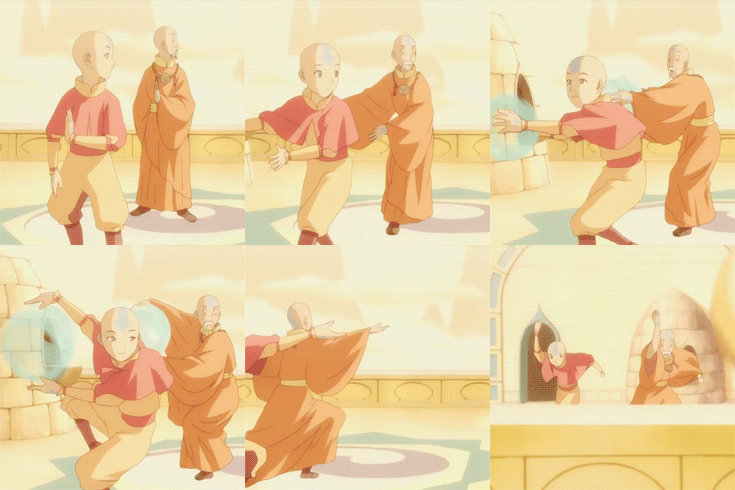
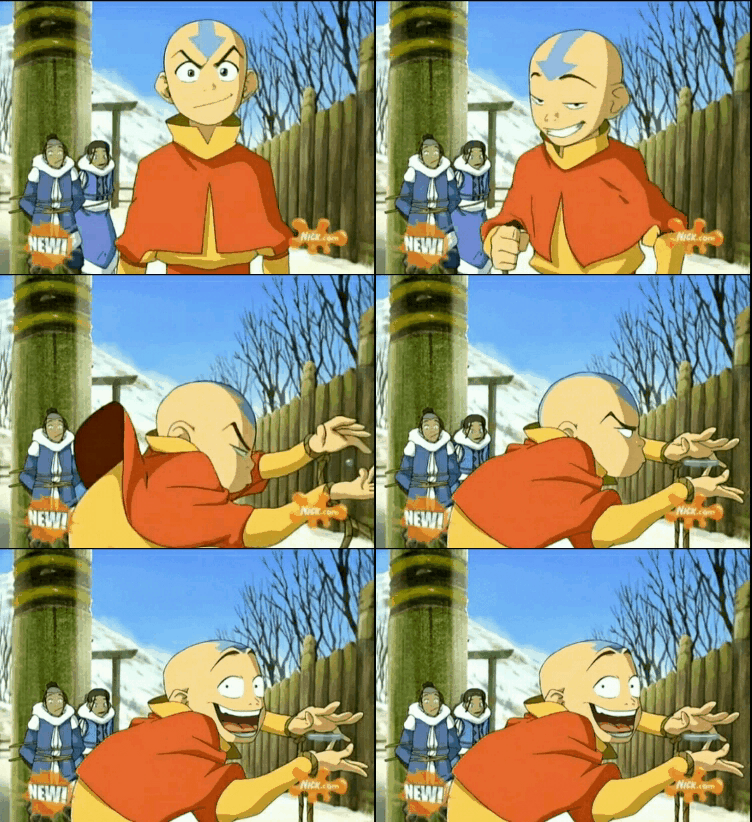
And then we have this guy.
The air nomads brought fun to the world. They brought a very literal sense of lightheartedness.
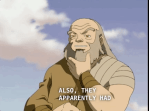
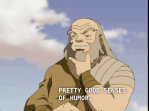
Sozin saw this as a weakness. I think a lot of the world did, in ATLA. Why do the Air Nomads bother, right? They’re just up there in their temples, playing games, baking pies in order to throw them as a gag. As Iroh said above, they had pretty great senses of humour, and they didn’t take themselves too seriously.
But that’s a huge part of having a world of balance and peace.
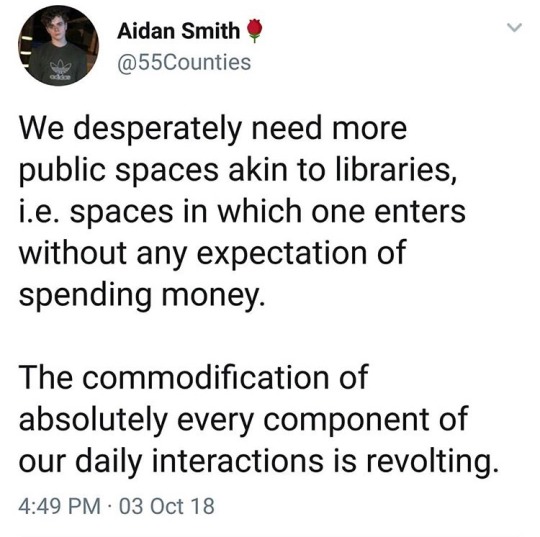
It’s not just about power, or might, or the ability to adapt. You can have all of those, but you also need fun. You need the ability to be vulnerable, to have no ambitions beyond just having a good day. You need to be able to embrace silliness, to nurture play, to have that space where a very specific kind of emotional growth can occur. Fun makes a hard life a little easier. Fun makes your own mortality a little less frightening to grasp. Fun is the spaces in between, that can’t be measured by money or military might. Fun is what nurtures imagination, allows you to see a situation in a whole new light, to find new solutions to problems previously considered impossible.
Fun is what makes a stranger into a friend, rather than an enemy.
I don’t know, but I don’t think this is a useful train of thought. Getting caught up in probabilities and potentials for the future can easily lead to either a crippling hopelessness or an apathetic sense of security, when what we need is motivation and urgency. Thankfully the recent UN report has spurred a lot of people to action, and I think we’re going to see more and more people abandoning the ineffective governmental/corporate means of protecting the environment in favor of popular movements
I think one of the best models for reducing the effects of climate change is Transition Towns, a grassroots movement working on a city-by-city basis to create sustainable circular economies. I like this one in particular because it’s community-focused, putting the power in people’s hands while leaving behind the big corporations that are causing the problem. 350.org is similar
The Buy Nothing Project is trying to build that community-controlled circular economy from the ground up. In particular, industrial agriculture is responsible for a good chunk of greenhouse gases, so growing your own food either in a personal or community garden (as well as producing your own eggs, goat milk, honey, etc. if you’re keen on that) is a good place to start. My practical tag has a lot of resources for this kind of thing
That said, we’re already seeing the effects of climate change, and things are definitely going to get worse before they get better, so focus some of your effort on helping the people affected by it. Mutual Aid Disaster Relief is pretty much what it says on the tin, people offering help after natural disasters – they were partially responsible for getting solar power to Puerto Rico following Maria (and they have a great list of other organizations on their site). We also need to support climate refugees – in the US that can mean stuff like leaving water out for migrants crossing the desert or sabotaging the wall, in Europe it means supporting groups like Sea Watch who are rescuing refugees at sea. And everywhere it means fighting fascism and any attempt to leave these people to die
Remember that citizens outnumber politicians, and workers outnumber capitalists. We have the power to put an end to this, we just need to organize and fight back. “If the workers are organized, all they have to do is to put their hands in their pockets and they have got the capitalist class whipped.“






 gayfeline