This cropped version of the Helix Nebula mosaic shows cometary-filaments embedded along a portion of the inner rim of the nebula’s red and blue gas ring. At a distance of 650 light-years, the Helix is one of the nearest planetary nebulae to Earth.
Credit: NASA, NOAO, ESA, the Hubble Helix Nebula Team, M. Meixner (STScI), and T.A. Rector (NRAO).
The artist conception shows a newly formed star surrounded by a swirling protoplanetary disk of dust and gas. Debris coalesces to create rocky ‘planetesimals’ that collide and grow to eventually form planets. The results of this study show that small planets form around stars with a wide range of heavy element content suggesting that their existence might be widespread in the galaxy.
I don’t think most people realize how terrifying the Moon Landings were. They look back at it, and see this great achievement in human spaceflight but don’t grasp the gravity of the situation. (No pun intended)
OP mentions Michael Collins, who is often forgotten. He was the third member of the Apollo 11 mission, who manned the Command Module whilst the other two landed with the Lander Module. People might hear that and thing he got the short end of the stick, but honestly… I’d argue the opposite. At 20:17:40 UTC on Sunday July 20 1969 the Landing Module touched down on the Moon. Neil Armstrong and Buzz Aldren spent 21 hours, 36 minutes on the surface of the Moon before beginning ascent to rendezvous with Michael Collins in the Command Module.
This is where things get unnerving. The thruster used on the Lunar Ascent Propulsion System used a hypergolic fuel, which is a fuel that spontaneously ignites when the fuel and oxidizer meet. Hypergolic fuels are useful for when spacecrafts need reliable ignition or repeated ignitions, however they’re nasty things. The specific fuel used for this thruster was a mixture of Aerozine 50 and Dinitrogen tetroxide. These are incredibly toxic, and more importantly incredibly corrosive. In fact, they are so corrosive that once you fire an engine you essentially have to completely rebuild it in order to reuse it. This means that the engine on the Lunar Ascent Propulsion System had never been fired before.
That engine was their bridge home. If it failed, they would be stranded on the surface of the Moon. As mentioned the Moon Landing lasted roughly 22 hours. For twenty two hours the two astronauts were on the moon, completely unsure if the never-before fired thruster would even fire up. Completely unsure if they’d be able to go home.
This picture shows the entirety of the human race on January 21st, 1969. All of it except the man who took it, that is. Micheal Collins stayed back on the Command Module during the mission to await Aldrin and Armstrong’s return… or potential lack thereof. This earned him the title “The Loneliest Man in the Universe”. For about 50 minutes for each orbit around the Moon Collins would be out of contact with the earth. That means for about 50 minutes during each orbit he’d have no way to contact any other human, completely alone over 230,000 miles from earth. For roughly 50 minutes during each orbit Collins had no clue whether his fellow astronauts were still alive, and them not returning was a very real possibility. Orders were in place that if the other two could not return to the command module that Collins would return alone.
This wasn’t just some disaster protocol either. This was a very real possibility. Both the astronauts, and NASA were very much prepared for it to happen. So much so that Richard Nixon, the president at the time, had a speech prepared if it were to happen. It doesn’t sugar coat it. It starts off
“Fate has ordained that the men who went to the moon to explore in peace will stay on the moon to rest in peace. These brave men, Neil Armstrong and Edwin Aldrin, know that there is no hope for their recovery.“
If that isn’t bone chilling, then I’m not really sure what is. People often romanticize space exploration, but back then, and even today, well… this is the reality of it. All of that is what astronauts go through.
The ancient Sumerians believed that Mars was Nergal, the god of war and plague. During Sumerian times, Nergal was a minor deity of little significance, but, during later times, his main cult center was the city of Nineveh. In Mesopotamian texts, Mars is referred to as the “star of judgement of the fate of the dead”. The existence of Mars as a wandering object in the night sky was recorded by the ancient Egyptian astronomers and, by 1534 BCE, they were familiar with the retrograde motion of the planet. By the period of the Neo-Babylonian Empire, the Babylonian astronomers were making regular records of the positions of the planets and systematic observations of their behavior. For Mars, they knew that the planet made 37 synodic periods, or 42 circuits of the zodiac, every 79 years. They invented arithmetic methods for making minor corrections to the predicted positions of the planets.
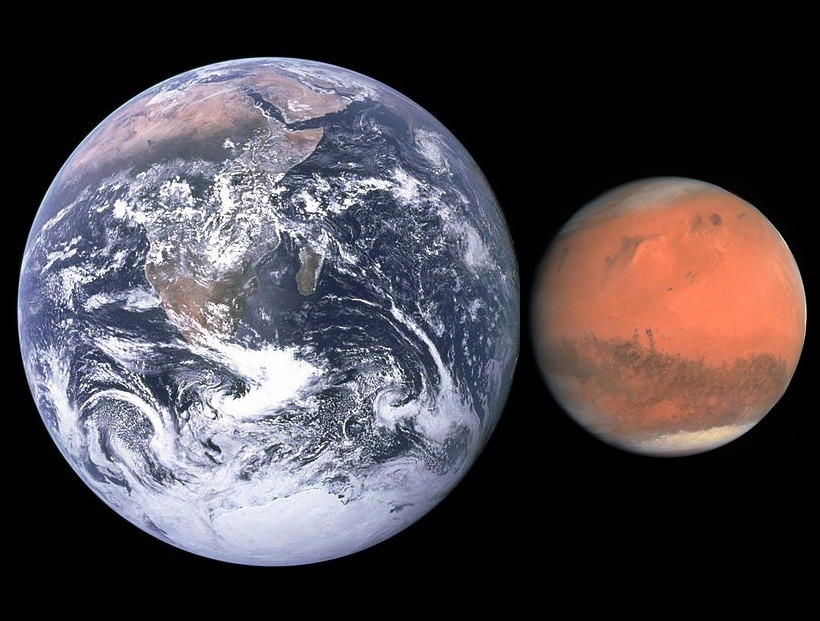
Mars is the fourth planet from the Sun and the second-smallest planet in the Solar System after Mercury.
The bright rust color Mars is known for is due to iron-rich minerals in its regolith — the loose dust and rock covering its surface. The soil of Earth is a kind of regolith, albeit one loaded with organic content. According to NASA, the iron minerals oxidize, or rust, causing the soil to look red.
The rotational period and seasonal cycles of Mars are likewise similar to those of Earth, as is the tilt that produces the seasons. Mars is the site of Olympus Mons, the largest volcano and second-highest known mountain in the Solar System, and of Valles Marineris, one of the largest canyons in the Solar System.
Mars has two moons, Phobos and Deimos, which are small and irregularly shaped. These may be captured asteroids, similar to 5261 Eureka, a Mars trojan.
There are ongoing investigations assessing the past habitability potential of Mars, as well as the possibility of extant life. Future astrobiology missions are planned, including the Mars 2020 and ExoMars rovers. Liquid water cannot exist on the surface of Mars due to low atmospheric pressure, which is less than 1% of the Earth’s, except at the lowest elevations for short periods. The two polar ice caps appear to be made largely of water. The volume of water ice in the south polar ice cap, if melted, would be sufficient to cover the entire planetary surface to a depth of 11 meters (36 ft). In November 2016, NASA reported finding a large amount of underground ice in the Utopia Planitia region of Mars. The volume of water detected has been estimated to be equivalent to the volume of water in Lake Superior.
Mars can easily be seen from Earth with the naked eye, as can its reddish coloring. Its apparent magnitude reaches −2.91, which is surpassed only by Jupiter, Venus, the Moon, and the Sun. Optical ground-based telescopes are typically limited to resolving features about 300 kilometers (190 mi) across when Earth and Mars are closest because of Earth’s atmosphere.
Like Earth, Mars has differentiated into a dense metallic core overlaid by less dense materials. Current models of its interior imply a core with a radius of about 1,794 ± 65 kilometers (1,115 ± 40 mi), consisting primarily of iron and nickel with about 16–17% sulfur. This iron(II) sulfide core is thought to be twice as rich in lighter elements as Earth’s. The core is surrounded by a silicate mantle that formed many of the tectonic and volcanic features on the planet, but it appears to be dormant. Besides silicon and oxygen, the most abundant elements in the Martian crust are iron, magnesium, aluminum, calcium, and potassium. The average thickness of the planet’s crust is about 50 km (31 mi), with a maximum thickness of 125 km (78 mi). Earth’s crust averages 40 km (25 mi).
Mars lost its magnetosphere 4 billion years ago, possibly because of numerous asteroid strikes, so the solar wind interacts directly with the Martian ionosphere, lowering the atmospheric density by stripping away atoms from the outer layer. Both Mars Global Surveyor and Mars Expresshave detected ionised atmospheric particles trailing off into space behind Mars, and this atmospheric loss is being studied by the MAVEN orbiter. Compared to Earth, the atmosphere of Mars is quite rarefied.
Mars’s average distance from the Sun is roughly 230 million kilometres (143,000,000 mi), and its orbital period is 687 (Earth) days. The solar day (or sol) on Mars is only slightly longer than an Earth day: 24 hours, 39 minutes, and 35.244 seconds. A Martian year is equal to 1.8809 Earth years, or 1 year, 320 days, and 18.2 hours
Mars is scarred by a number of impact craters: a total of 43,000 craters with a diameter of 5 km (3.1 mi) or greater have been found. The largest confirmed of these is the Hellas impact basin, a light albedo feature clearly visible from Earth. Due to the smaller mass of Mars, the probability of an object colliding with the planet is about half that of Earth. Mars is located closer to the asteroid belt, so it has an increased chance of being struck by materials from that source. Mars is more likely to be struck by short-period comets, i.e., those that lie within the orbit of Jupiter. In spite of this, there are far fewer craters on Mars compared with the Moon, because the atmosphere of Mars provides protection against small meteors and surface modifying processes have erased some craters.
Martian craters can have a morphology that suggests the ground became wet after the meteor impacted.










 gayfeline